




 610 m
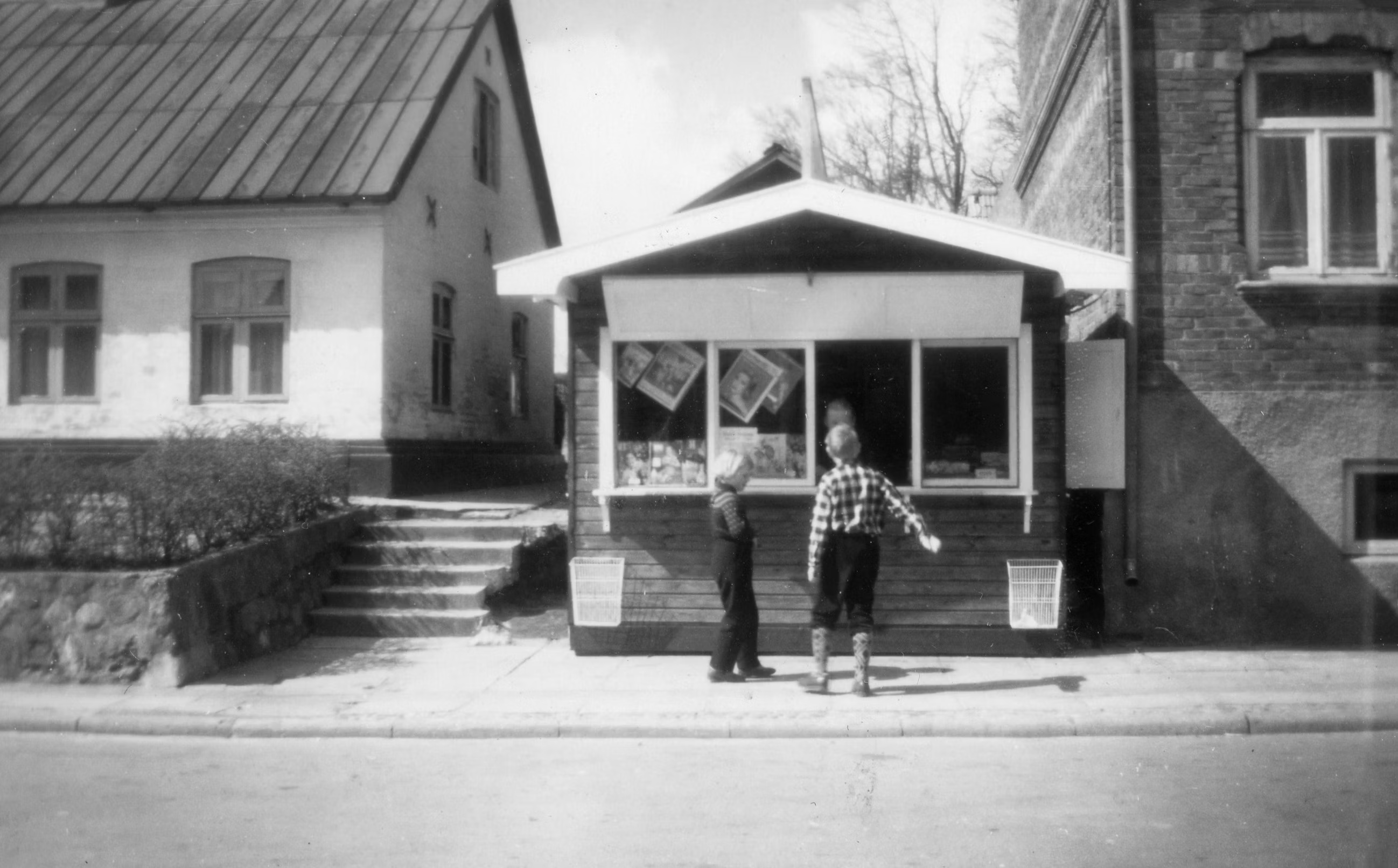
Ansager in the 1950s seen from a child’s perspective
A close childhood memory of the same town, with the 1950s and everyday details as background
And then we were going to move, down to Søndergade. There were no numbers on the houses back then, and it wasn’t necessary either, because ”we” all knew one another, except us children. So moving was extra exciting: new neighbors, new shops, new everything. The house we moved into was not exactly luxurious, a long, low house whitewashed with yellow lime and a red sheet-metal roof. With a small garden shop at one end.
The privy was a proper privy, placed out in the peat shed. A shed of considerable size compared with the dwelling, intended as a washhouse, with a small compartment for the privy. The rest was for firewood for the stove and tiled stoves. It took space to store fuel in those days. It consisted mainly of peat (klyyn), which could only be dug and dried during the summer period and then had to be stored for the entire winter’s consumption. ”But it wasn’t bearable having an outside privy,” although the previous residents had done so for 50 years. Fortunately, the pantry was so well proportioned that room could be set aside for an indoor toilet. There was no need for a bathroom. We had the big zinc tub in the kitchen.
Heine had also arrived in the meantime; the stork had been there. That was the day I stopped calling myself ”little,” I have been told. When I first saw Heine, I said to the midwife: ”No, now I can’t stop myself from laughing, but thank you for him.” Kurt, Heine and I got the small room, approx. 1.50 x 3.0 m. Heine and I in bunk beds, Kurt in an ”adult bed.” We were happy there. But damn, it was cold in winter. There was no heating installed in the bedroom or the small room.
Mother and father had hot-water bottles for warming the bedding. Instead, well in advance of bedtime, we children got a stone or a brick placed in the oven. Half an hour before we were to be chased to bed, the stones were wrapped in newspaper and placed in the beds at backside height. And when we then crawled under the duvets, we pushed the stones down to our feet. After about 5 minutes we were done chattering our teeth, and then we could lie there talking in a ”know-it-all” way and enjoy the warmth from the stones at our feet.
Back then, it was like this: we children got a pair of rubber shoes (sometimes tennis shoes, which had to be whitened with a toothbrush) for summer use. For winter use, we got a pair of rubber boots. Sometimes we had a pair of leather shoes (raw rubber shoes) for ”special occasions.” They were then passed down to the younger siblings when we grew out of them, and that happened, because you couldn’t wear them out in time. And that was despite the fact that they were always bought a couple of sizes too big, ”there had to be something to grow into.”
Continued Friday 4.12.2020


